
Editorial
News
News is…
Newly received or noteworthy information, especially about recent events. — Oxford Dictionary of English
A report of recent events, previously unknown information, something having a specified influence or effect. — Merriam-Webster Dictionary
When a dog bites a man, that is not news, because it happens so often. But if a man bites a dog, that is news. — Collins Dictionary
There is nothing new about news. It has always existed. For millennia news could only travel as fast as a man or horse could walk or run, or as a ship could sail. News of destructive natural phenomena, such as earthquakes, floods, volcanos… occurring a thousand miles away could take years to reach the public. The same was true of human events, such as uprisings, wars, births and deaths.
“The shot heard round the world,” a symbolic phrase used to describe the opening shot of the Battle of Concord on April 19th, 1775, which began the American Revolutionary War, even on the North American continent was probably “heard” only weeks or months later by many.
Today we are in the era of instant news. “Shots” are literally heard around the world in a matter of minutes. With the ubiquitous cell phone and security cameras capturing much of what happens in populated areas, instant replays are now commonplace on most major news outlets.
Our daily supplication is giving way to “Give us today our daily news.” To be totally isolated from any kind of news for a week would place many of us under a severe mental strain. And for those who stoutly proclaim that “ignorance (no news) is bliss,” we remind that news, in its broadest sense, includes information or insights obtained through the media, on the internet, on the phone, on the street, in the backyard, from friends, school children, the family, alas, even in church…
What does “Fake News,” a term seen and heard daily in the media, really mean? (Interestingly, it is a term that has been solidly incorporated into the Portuguese lexicon. To deliberately propagate malicious fake news is now a prosecutable offense in Brazil.)
To identify fake news we need to understand what is NOT fake news.
BIASED NEWS. A bias is “an inclination of temperament or outlook… a personal and sometimes unreasoned judgment” (MW Dict.). We are seldom truly neutral in our opinions and understanding of facts. Much of what we consider to be sound informa- tion is based on what we learned from our parents or teachers in childhood, have expe- rienced, have read or has been passed on to us as reliable. Writers, speakers, editors, reporters, preachers, teachers and parents all have biases. This is totally normal. We are often unconsciously defined by our biases.
Just as individuals carry biases, so do news organizations. The editorial guidelines for a news organization reflect the biases of the owners and the staff. This is what gives “personality” to what is reported. Indeed, this is what often makes us like or dislike a particular news source.
A normal bias does not constitute fake news.
MANIPULATED NEWS. We have now progressed beyond biased news. Manipu- lated news is not a distortion of facts. It is a selection of what will be aired to the public. We will call it “selective news”.
It isn’t only the media that knows how to use selective news. So do our children. Mom: How was school today?
Son: I got an A in math. Mom: That is wonderful!
What son didn’t tell mom is that he got a C- in geography and a D in composition. Did son tell the untruth? No. Was he honest? Not really.
Increasingly, news organizations are relying on selective reporting. I am unaware of a truly neutral news source that objectively reports current events. This is true on both the left and the right. It takes but a moment to discover the “inclination” (as MW puts it) that is projected. Thus, most readers or viewers choose the source that most agrees with their own views. While no organization is perfect, some are much more conscien- tious than others.
When Ronald Reagan, a classical conservative, became president his aides were curious to know why he not only wanted conservative publications on the table for his daily breakfast read. He asked for publications that reported negatively on his presidency. He explained he needed to see both sides of the coin (not in those words) to understand how he was doing.
Call this the “Ronald Reagan Rule”, if you will, but for readers who follow the news, the RRR is important. Not only does it give a more balanced view, it is amazing what we can learn from what is on the other side of the coin. In a previous issue of this little paper I told about President Ronald Reagan, an ardent conservative, and Speaker of the House Tip O’Neill, a died-in-the-wool liberal. In spite of their political divergences, they were close friends. When Reagan was struck by a would-be assassin’s bullet, he was narrowly saved from death by the skill of surgeons. Once in recovery, he was not permitted to have visitors. Even so, he requested that his friend Tip O’Neill be allowed to visit him. When Tip entered his room and saw the condition of his friend, he knelt at his bedside and wept.
And then there is Antonin Scalia, the ultra-conservative Supreme Court justice distin- guished by his Constitutional originalist philosophy, which advocates that the Constitu- tion of the United States means exactly what it says, and the ultra-liberal justice, Ruth Bader Ginsburg, who believes the Constitution should be interpreted as the founding fathers would have written it if alive today. In spite of being poles apart on their judicial views, and seldom concurring on crucial cases, they were the closest of friends. Gins- burg was chosen by Scalia’s son to write the introduction to the biography of his dad’s life. They would be seen together in public and cultural events.
This is the embodiment of the RRR. It has a very definite spiritual application. The grace to not only carefully listen to both sides of a question, but to actually value and learn from those whose views differ from ours is true wisdom.
Like the little boy who told his mom only part of the story, manipulators splash certain news over the front page in glaring headlines, while their competitors don’t so much as give it an inch and a half of column space in normal print on page 17.
SENSATIONAL NEWS is not fake news per se. Rather, it is intended to be… well, as the name clearly indicates, sensational. It is meant to elicit “Ohs!” and “Ahs!” from the readers. Sensationalism is an advanced form of exaggeration. As there is often no political agenda. the exaggerations can be left or right, up or down, black or white, so long as they attract gullible readers. It should be pointed out in bold type that sensa- tional publications should be off-limits for Christians. They do not qualify under RRR. Nothing useful can be gleaned from these exaggerations, very often of a sensual and diabolical nature.
PERSONAL PROMOTION NEWS is usually spread by well-intentioned individuals or groups. This kind of news is very credible because its obvious objective usually is to help and not to hinder. I am amazed at how many messages show up on my What- sApp with the prevention or cure for coronavirus and other maladies. Research, statis- tics, personal testimonies, and logical arguments are presented. It isn’t our intention to qualify these purported cures. Rather, we want to point out a tendency in some cases to cast a shadow on the efforts being made by medical science. Worse is when conspiracy theories, either veiled or explicit, are promoted to show that medical science, health orga- nizations or multinational laboratories are deliberately misleading the public for unscru- pulous gain. We recognize that this can, and surely at times, happens. It is important to remember that innumerous health benefits that daily save lives are the direct result of scientific advancements. Even those who disparage modern science, when faced with a potentially fatal sickness, usually seek out conventional aid when all else has failed. In a word, we should be careful about suggesting alternative cures that would cause especially those with life-threating illnesses to lose confidence in medical science. The time lost before conventional help is sought can prove fatal.
FAKE NEWS is a deliberate and malicious attempt to deceive. This can be for personal advantage, for monetary gain or—as is so often the case—for political or elec- toral purposes. Again, RRR does not apply.
Fake news is never well-intentioned and comes in many forms. We mention a few:
Adulteration of poll results. This is used in an attempt to make a losing candidate appear as a winner, or a winner as a loser.
Character denigration. An innocent party can be falsely accused of inappropriate conduct or even of crimes committed. This tactic is routinely used on candidates for public office or individuals selected to occupy sensitive governmental positions. These attacks invariably are ruthless, hostile and when not completely false, based on blown- up interpretations of insignificant facts having occurred often decades prior. False or prejudiced witnesses are called on to substantiate these allegations.
Attempts to subvert authority, the lowest form of fake news. It is both malicious and deadly. This is a concerted attempt by criminal elements to undermine and over- throw democratic rule. It is important to remember that this kind of fake news usually comes with attractive gift wrapping, but should an attempt be made to contact those responsible, or even to pursue their writings, true intentions soon are revealed. It is superfluous to say that this kind of news should be avoided like the plague.
SO, WHAT DO WE DO WITH FAKE NEWS?
1) Detect it! The fact you do not agree with what you read or see does NOT mean it is fake news. Nor is all you read, hear or see saturated with fake news.
Back in the days when we had 20% plus inflation here in Brazil — that’s per month, not per year — bank tellers had to count stacks and stacks of bills. They did it by touch. As they counted, their hands flying at supersonic speed, they would look around. If a friend came into the bank, they would smile, nod a greeting, without missing a beat.
One day when I was at the window the teller was counting my money she suddenly stopped, held up bill and said, “This bill is counterfeit.” She showed it to me and pointed out the telltale signs. How did she do it? Counting thousands of bills per hour, there was no way she could visually examine each one. She knew what a real bill felt like, so in the split second that her sensitive fingers touched the counterfeit bill she sensed a difference. She obviously didn’t develop this talent on her first day at work.
To detect fake news you must train your mind to get the feel of authentic news. You won’t learn this in one day. But with the passing of time, you will notice that certain news “feels” right, while other raises little red flags.
THE FAKE NEWS WHICH DOTH SO EASILY BESET US.
Gossip is a sort of smoke that comes from the dirty tobacco-pipes of those that diffuse it, it proves nothing but the bad taste of the smoker. — George Eliot Daniel Deronda
Casual or unconstrained conversation or reports about other people, typically involving details which are not confirmed as true (Oxford Dict.).
Let’s say it like this: Gossip is something we wouldn’t even consider telling the person being gossiped about, but feel an immense satisfaction in telling others.
Like fake news, gossip has no redeeming quality. It ranges from benign to malignant. In its malignant form, it would merit a place in the Martyrs Mirror as one of the great persecutors of the children of God through the ages — with one deplorable difference. Those martyrs slain during the centuries left a living testimony of departing this life on their way to their eternal celestial home. Those slain by the Nero of gossip are often mortally wounded and leave no such hope.
There are two kinds of gossipers: the active gossiper and the passive gossiper. In plain English, for gossip to exist there must be a mouth and an ear. The mouth does not gossip alone. It needs an ear — or ears. The mouth is the perpetrator of the crime, while the ear — in legalese — is the accessory. “Someone who gives assistance to the perpetrator of a crime without taking part in it” (Oxford Dict.). Thus, to listen to gossip, even in total silence, makes one an accessory, and guilty.
We have suggested how to deal with fake news. Now we make a few suggestions on how to combat gossip:
Gossip often begins as a normal conversation, but at a certain point there is a change of “tone.” Someone who detests gossip will almost immediately note this difference in “tone.” When this happens, there are several options:
- Show disinterest and drop out of the If that doesn’t do it, ask, “Have you talked to so-and-so about this yet?” It is amazing how that little suggestion is a pitcher of cold water in the face of the gossiper.
- Try a courteous “I know so-and-so and I am quite sure that is not true.” If that doesn’t work, excuse yourself. Say you have a lot of work waiting (who doesn’t?) to be done.
- If there is open maliciousness in what is said, give a frank appraisal of the “Yes, I know that he/she is going through a difficult phase. If we can have the right atti- tude and try to lend a hand, instead of being critical, I believe things may change for the better.” If the atmosphere doesn’t change, change your venue.
We repeat, gossip, like fake news, has no redeeming quality. To argue with a gossiper is non-productive.
And for gossip to contaminate, there must be a mouth and an ear. So wear a mask — one that covers your ears.
(Continued on page 14)
Going through some of the earilier issues of BN, I ran across a few articles that I believe warrant a reprint. Since they were published nearly 25 years ago, quite a few of you weren’t subscribers then; others may have read these stories, but forgotten the details. So here we go:
Brazilian stories
Run Over by a Ship (almost)
by Anna Kramer
[This story is told by Anna, Mrs. Daniel Kramer, during the time they were missionaries in the northeastern state of Ceará.]
Acaraú, in the state of Ceará, is a fishing town on the northern coast of Brazil, about 230 km. west of Fortaleza. However, it is about seven kilometers from the ocean and the Acaraú River on the west side of town, where the fishing boats have access to the ocean on high tide. Many of the locals were born and raised here. Their horizon is limited to the vast, endless deep sea. Most of them are fishermen by trade.
Many of the fishing boats used by these people are approximately 36 feet long and 10 or 12 feet wide, with a cabin about 6’ x 10’, with three bunks on each side. They use a MWM 4 cylinder diesel motor to power these boats. It was on a boat of this description that the men in this story suffered shipwreck.
This is the story that Raimundo Peres, age 46, father of eight children and a resident of Acaraú, told to Daniel and me:
August 6, 1996 was a normal day for us fishermen as we left the harbor for another 18- to 20-day trip. I have been a fisherman since about 16 years of age and have worked out of different harbors, including Fortaleza.
I knew the water was dangerous, but being a good swimmer, I wasn’t afraid. Fishing and the challenges that go with it made up my life. When we returned from a fishing trip, I would soon be in a bar drinking. For several days I would stagger around on the streets, totally drunk. This caused my wife and family a lot of grief and they were ashamed to be seen with me when in this condition.
Soon I would return to the ocean, so my family saw very little of me. I must say that I have a wonderful family and they did everything they could to help me. So about three months ago I decided this kind of life couldn’t go on. I quit drinking. Life has been much better since then and my family is happy. I really believe it was God who helped me over- come this bad habit.
On August 20, after having been on the ocean for 15 days, we had a nice catch. We would fish for two more days before returning to shore. By now we had about 450 lobsters (150 kilos) and around 30 kilos of fish. May, June, July and August are the four months of lobster fishing, and although we were fishing for lobster, we also had a nice catch of fish, including a fish I was going to take home to my friend Daniel Kramer.
In the late afternoon we cleaned the day’s catch, put them in the ice box and prepared for the night. We had already all been in bed sleeping, when about 10:00 p.m., the captain awoke and said he dreamt a ship ran over us. I was also awake, so he told me he was going on deck to check a line he left baited in the water. As he opened the door and stepped outside, to our horror and surprise, there sure enough was a big ship coming upon us. There was no time to start the motor or get out of the way.
When we drop anchor for the night, the boat remains west of the anchor, facing to the east, which puts it into a favorable position to ride the waves. The ship came from the southwest. Had it hit us broadside, our boat would have been shattered and we would have sunk immediately. What saved us was that it was a glancing blow.
By this time I was up and on deck. I hurriedly cut the anchor rope so we wouldn’t be drug along by the ship. The impact of the hit threw the captain against the ship and then back onto the deck. He was badly bruised. Our boat was also badly damaged and began to sink. The other four crew members crawled out of the cabin onto the now submerged deck. Our boat had two fuel tanks, and since our fishing trip was about over, they were practically empty, so they served as floats to keep our boat from sinking. But even so the deck was under water.
The large ship continued on its way, never knowing it had hit a fishing boat. It looked like an enormous apartment building slowly going by with its many rows of windows and lights. It seemed like a long time before it was finally past.
There was nothing we could do except hang on to our swamped boat until morning. In the meantime wave after wave rolled over us. When morning came, we hoped and prayed and watched for someone to come by and rescue us, but no one showed up. We saw a few boats in the far distance, but they didn’t see us. Also, during that long day two more big ships went by, but thank God they didn’t come toward us.
One of the fuel tanks sprang a leak and began filling with water. About noon the stern began to sink. Soon the boat was standing on end in the water, with only the bow above the surface. Was our whole boat going to sink and were we going to go down with it?
We all six hung on to the bow, on to a rope and on to each other. We tried to keep our courage up by saying that God would surely send someone to rescue us.
But that day passed with no rescue, with no water to drink and no food. Once the youngest member of the crew, a lad of 16, said he was hungry and thirsty, but we all encour- aged him to pray and ask God to rescue us, rather than to think about food and water. We chewed on black plastic to keep our jaws from locking up.
By ten o’clock that evening we were becoming desperate, but what could we do? I thought about my wife and children and prayed for courage to hang on. Suddenly I saw the light of another fishing boat off in the distance. I told the rest of the men that I was going to try and swim to that boat. At first they didn’t want me to go. They thought we ought to stay together. I told them this was our only hope. I also told them that they could stay and wait, but when they saw I was determined to go, they all decided to go too.
They were all hanging on to plastic water jugs and one had a small empty propane bottle. I started swimming in the direction of the light. I called back to my buddies and they answered. But after about the fourth time I called them, they didn’t answer anymore. A fear gripped my heart. Had the sharks gotten them? would they get me too? I prayed again and asked God for courage and strength.
Soon I saw some dolphins swimming around. This made me feel better because I knew that dolphins and sharks aren’t usually seen together.
As I would ride the crest of a wave, I’d look for the light, then swim as fast as I could in that direction, rest a bit and repeat this procedure each time I rose up high enough to see the light.
By four o’clock, when the morning star appeared, and I still hadn’t reached the boat, I knew I had to get there before daylight, or I wouldn’t be able to see the light anymore. So again I prayed for strength and swam on.
When daylight came at about 5:15, I was in sight of the boat. When the cook came to the deck to begin the day and prepare breakfast for the men, he saw me in the water. Immediately they threw a rope and helped me aboard. As I hit the deck, I fainted, but they soon revived me. After giving me milk to drink, they asked me if there were more men out there. I said, yes, there were five more men in the same direction I had come from, floating on jugs. Then they helped me to bed and I fell asleep.
They went in search of the others and found them. When I awoke, we were all six on the boat. They then radioed back to the company that we work for and told of our wreck.
They said we were all alive, although some of us were in bad condition, and that we would be getting in before the next morning.
We then started for land and arrived home at one o’clock in the morning on August 23. My wife and daughters were overjoyed to see me. My eyes were so red and sore I could barely see and my throat so sore I could only swallow milk for several days. My chest muscles ached from swimming so long, but I thanked God I was home.
The captain was taken to the hospital, where he remained for several days before being released. We all suffered much from the bruises and salt water, but have all recovered.
The company sent three boats in search of our wrecked one and found it. They towed it to the harbor. The only thing that was salvageable was the motor. Three days after I was home, a friend brought me my watch. It had been found in the boat. It is still working.
I feel it is a miracle and only by God’s help that I am alive. My wife and daughters do not want me to return to the ocean, and I admit I have a little fear, but I’ve been a fish- erman all my life and don’t know what else to do. (Following are two stories by Mário de Moraes, a syndicated journalist I have attempted to contact
him or his heirs for permission to use his stories, but have never gotten a reply.)
Honest Abílio
By Mário de Moraes
It’s amazing how that honesty is many times our best defense. That is the case in this story of Abílio César de Almeida, that took place many yesterdays ago in the lovely city of Salvador (state of Bahia).
Before I get started on my story, I want to tell you a little about Abílio (pronounced ah-bee-lee-oh). A baiano (someone born in the state of Bahia), he is honest right down to the marrow of his bones. One hair from his beard is worth more than any document that you can have notarized. It’s hard to find someone like him around anymore. The only reason I don’t say that he’s the only one left, is that I have found that there are exceptions to all rules. Abílio told this story to Almir, his dad-in-law, who is also an outstanding reporter.
All this happened one day while Abílio was walking to his daughter’s house in an area of town known as Queda Brusca.
“Watch it there! You almost stepped on a diamond ring,” a young man said to Abílio.
Looking down on the sidewalk, he saw the ring too. The stone glittered in the sun.
After Abílio picked up the ring, the young man came up closer and examined it with the older man. With the large stone, it was an impressive looking piece of jewelry.
“That sure does look like a diamond to me,” was the young man’s comment. “And the ring itself seems to be pure gold.”
“It does, doesn’t it,” was Abílio’s only answer. At that time he was working for the post office. “I’m sure that’s a genuine diamond,” the young man insisted. “I’ve seen diamonds before.”
“You might be right,” was all Abílio would answer.
“And if it is, it’s worth a fortune!” exclaimed the young man.
“I’m sure I don’t know,” was Abílio’s rejoinder.
If Abílio would have been the suspicious type, he certainly would have noticed the strange glint in the young man’s eyes when he made his suggestion. “I’ll tell you what. It’s plain to see that you’re an honest man. Since we sort of found this ring together, I would say that it belongs to both of us. So, since you’re the older of us, go and sell the ring and we’ll split the money 50/50. Does that sound fair enough?” Before Abílio could answer, he continued.
“But there’s just one problem. I’m flat broke. You look like you’re not hurting finan- cially. Since I could use a little money right now, how about paying me some before you sell the ring? We can set a place to meet later on and then you can give me the rest of the money. How about meeting at two o’clock this afternoon?”
This is where Abílio’s honesty showed up.
“Nothing doing. You’re the one who saw the ring first, so it’s yours.” “No, you picked it up, so it belongs to you,” argued the young man.
When Abílio tried to hand it to the young man, he backed away. “OK then, it’s ours.” But Abílio would hear nothing of it. “It’s yours! Here take it!”
Seeing there was no point in arguing with Abílio, the young man, obviously upset, turned his back on the older man and began walking down the street in rapid strides.
When Abílio got to his daughter’s house and told his son-in-law what had happened, he was in for a surprise. Almir told him that that whole thing was a trap. If it wouldn’t have been for his honesty, he would have ended up with a worthless ring—and consider- able less money in his pocketbook.
[ Just a word on this. This trap, known as the conto do vigário, has innumerous variations, but the basic element is always the same. Someone just finds out that the lottery ticket he purchased is a winner. All he needs to do is go to the bank with it and get his money. But he just found out that his youngest child has been involved in an accident in another town. He must leave immediately and won’t have time to go to the bank to cash the ticket. If the person will pay him only a fourth or half of what the ticket is worth, he can just have it. By now he may be wiping tears. It’s all a sham. Whatever he gets out of the deal is clear profit, since the ticket is worthless. It’s amazing how often it works. The police are really rough on people they catch pulling this stunt.]
Tamanho Não É Documento
[A direct translation would be: Size is not a document. That really doesn’t make any sense (unless you know Portuguese), so we’ll give it a looser translation: Don’t judge someone by his size. This is a frequently used expression here in Brazil.]
Delfino wasn’t exactly a midget, but he was mighty short. Twenty-eight years old, he was less than five feet tall and weighed a little of nothing.
Being short didn’t bother Delfino. Happy-go-lucky, extroverted and a nice chap to be around, he was liked by all. That doesn’t mean that he didn’t have to take a lot of ribbing about his size. But even that didn’t bother him. Some of his nicknames were of his own creation.
Delfino lived in a town in the state of Minas Gerais. Even the children loved this little man. His boss and co-workers thought the world of him.
An only child, he lived with his mother. The only thing that kept him from being totally happy was the fact that he wished he could get married. When his friends would try to encourage him, he would say:
“Have you ever tried to imagine how a little fellow my size would go about finding a wife? No, it just wouldn’t work…”
When everyone had given up hope of Delfino ever getting married, things took an unexpected turn. One of the girls he worked with began seeing him with romantic eyes. The interesting part of it was that she was six feet tall and weighed well over two hundred pounds. And so, on their wedding day, the guests had a hard time keeping sober as they beheld this tremendous contrast.
The reception was in the factory warehouse where they worked. Finally everyone went home.
During the night the neighbors to this new couple were awakened by a hideous racket.
Unable to sleep, they finally called the police.
Officers rapped loudly on the door several times. When no one answered and the din continued, they kicked the door in. There they discovered what all the yelling was about. Delfino was beating the tar out of his new wife.
Hauled to the delegacia (police headquarters), he explained to the delegado (chief of police) what was going on:
“It was no big deal, Chief. Rosária is a mighty fine wife and I have a real crush on her. But have you ever stopped to think, Chief, what could come out of all this—tiny little me and enormous she? She could just decide that I wasn’t much account and decide to rule the roost. You know what I mean, don’t you? That’s why I decided to set things straight the very first night. That way Rosária will understand that tamanho não é documento…”
And it worked. Delfino and Rosária raised a number of children and lived together happily ever after.
Life in Brazil
Covid 19
As I sit here working on this issue of BN, news just flashed on my iPad, here at my side, announcing Brazil has just hit the 100,000 mark of Covid 19 deaths.
Our story here in Brazil is probably not so dissimilar from that of other countries hard- hit by the plague. Following is a quick run-down of how events have unfolded:
- News that a potentially dangerous virus has been With this comes a feeling of relief that China is on the other side of the globe.
- Warnings that the virus is truly dangerous and is Europe and Asia are a long ways from here and probably we are safe.
- Disturbing news that the virus is not constrained by geography or international frontiers and that it has been detected in our own country. Even so, in our state no cases have been spotted, nor of course in our local town or community. Fingers crossed.
- Cases are mushrooming in our country and there have even been cases in our community. In fact, there have been several deaths in our local Okay, so it is serious.
- Quickly certain words become part of our daily vocabulary: coronavirus, pandemic, isolation, social distancing, lockdown, masks, alcohol gel, Covid 19…
- The death rate in our own country accelerates and Coronavirus is no longer an abstract threat from the other side of the It is here and it has altered our daily routine in ways unimaginable mere weeks earlier. We now feel a sense of real danger.
- And now comes the complicated Coronavirus is no longer a stand-alone medical crisis, but it has become political and social as well.
Political. I don’t believe any explanations are necessary here. It is very similar to what is happening in the US. Parties are blaming parties.
Social. Again, like in the US, we have a multitude of self-appointed specialists who know much more than authorities about how to handle this crisis.
No matter how you figure it, we have a serious problem. Here is what I read today in
O Popular, our Goiânia daily:
In less than six months Brazil has reached the 100,000 mark of coronavirus deaths. The 8th, Saturday afternoon, there were 100,204 deaths according to official statistics. If the country would decree one minute of silence for each victim, we would have to remain silent for 70 days. Impressive, to say the least. It is the equiva- lent of five fully loaded Airbus A320 passenger jets crashing each day if we begin counting from March when the first death occurred. Or the equivalent of one and a half Morumbi soccer stadiums, the largest in São Paulo. So, is it serious? You decide.
Remembering Out Loud
The Name Says It All
Already in Bible times, a name could help identify an individual: Simon the leper, Simon a tanner, Simon the Canaanite, Matthew the Publican, John the Baptist, to mention just a few.
While visiting my uncle and aunt here in Kansas, the conversation drifted to the subject of names. Memories began to come back of the curious nomenclature that evolved in the Dutch dialect to identify the many Johns, Bens, Daves, Petes, Jakes, and others, who often shared both the same first and last name. Beyond the normal descriptive names, a possibly unique feature was the usage of the wife’s name before the husband’s. Thus: Katreena Jake (Unruh) Susie Jake (Unruh), Lena Jake (Unruh), and Minnie Jake.
On the Bens we have Carrie Ben (Koehn) and Ida Ben (Koehn).
The Daves. Tilda Dave (Koehn) and Nettie Dave (Becker)—my grandpa. The Petes. Eva Pete (Unruh), Carolina Pete (Unruh) and Dina Pete (Unruh).
Some of the descriptive names were self-explanatory: Blind John, Deaf John, Big John, Little John, Little Pete, Fat Jacob.
As is common in many languages, there were the names derived from the person’ profession. There was a Thresher John and a Thresher Pete, in a referral to the days when grain was cut with binders, shocked and then hauled to the threshing machine, run by a steam engine, to separate the grain from the straw. To be in charge of either the steam engine or the threshing machine, brought a certain amount of prestige to the person. There was School Teacher Pete Johnson.
One of the most interesting is “Culla” Dave Koehn. In addition to his normal activi- ties as a farmer, Dave exercised the now defunct art of the “chicken culler.” While some called him Culler Dave, the majority used the Dutch version of Culla (which, who knows, may have been borrowed from the English).
To raise a few head of cattle, a few hogs and some chickens used to be just as Menno- nite as the John Deere tractor is today. The chickens obviously weren’t cage layers. During the winter they would be penned up in a chicken house and during the summer they would often run loose. This made it impossible to know which ones were productive. Hence the chicken culler. By palpating the bird, a good culler could, with reasonable accuracy, deter- mine whether it would be more productive in the nest or in the frying pan.
I still have pleasant recollections of Culla Duft (as he was known in Dutch) coming to our place to practice his art.
Some names reflected a physical characteristic. Slim Jake was, of course, a slender person, and Fat Jacob was heavy. Straight Back Tobe had extremely good posture. Black Simon had a darker than average complexion. Curly John very likely had curly hair. Honest Pete surely was honest.
Some of the names apparently referred to the place where the person was born or resided for some time. We have Dakota Ben (Koehn), Alabama Joe and California Red. This last one gives us a double dose. Did this man from California have red hair? Finally, the dutchification “Foola” Ben. Self-explanatory.
There were names that came about because of some unusual habit or happening. After coming over from Russia, Pigeon William (Koehn) built a pigeon house and raised pigeons for commercial purposes.
The name Costa Fritz evokes a chuckle from people who knew him. Costa is the dutchification (not in the dictionary) of “coaster,” so we’re really talking about Coaster Fritz. Old-timers tell of how he would come roaring over the crown of a hill in his road- ster and gather speed as he sped down. Suddenly there would be silence and Costa would be coasting. Every chance he had, he would repeat this procedure.
Then there was Shida John. Shida means “divorced” in Dutch. I’m not sure if he was divorced or if it was the woman he married.
Creek Tobias Unruh is to have lived along some creek.
I didn’t have the time to check out the history of all the names. Among these we have Civa Abe, Birdie Abe and Dubra John. All I know about Dubra John is that he came over from Russia. We have tried to avoid printing the names of people who are yet living. Nevertheless,
in case we have goofed and you find your name in this article, take cheer, you’re not dead.
We’d appreciate some imput from you readers. Do you know of any interesting names and their history? Let us know if you do.
I would like to thank my great-aunt Mornie Unruh, age 97, who supplied me with many of these names. Today, decades later, she is no longer with us.
Life on the Colony
The Fire Brigade
We are in the middle of our “winter,” better known as dry season. Relative humidity frequently drops into the teens and it takes but a spark for our countryside to break into flames. And this happens often. Since no-till farming has taken over several decades back, farm ground is covered with dry stubble. Pasture land needs no explanation. And what isn’t being farmed or pastured is in woods. So we are a tinderbox.
As can be imagined, fires are frequent. A few can be attributed to arson, some to tossed cigarette buts, quite a few to carelessness, some to sparks generated by defective machinery, and often to electrical shorts in our power lines that send sparks into the dry vegetation underneath the lines, that quickly burst into flame. With a strong wind, in a matter of minutes smoke is rising from a roaring, rapidly spreading fire.
Fires wait on no one. Knowing this, the men on the Colony have formed a fire brigade. The moment smoke is spotted, information is posted on an emergency WhatsApp number with the direction and volume of the smoke. Quickly the fire in pinpointed and it is decided if it is within range of local equipment.
As a rule within several minutes different ones come online to inform they are on their way. It isn’t unusual for ones to respond saying they are in town, but that their tractor and water tank are available. By this rapid response time, most fires are extinguished without major damage.
I think it is important to point out that if the fire is within range, no distinction is made between Mennonites and non-Mennonite neighbors. Without a doubt, this makes for good community relations. I tip my hat to those who are making it a success.
Solar Energy
The same cloudless days of our dry season that increase the fire hazard are a boon to solar energy. Different ones here on the Colony now have solar systems, which range from household use to an irrigation setup and grain storage project, as well as a number of sets of chicken barns.
The banks give low-interest 10-year financing. So far as I know, owners of these proj- ects are happy with the results. I have installed solar panels in both of my sets of chicken barns. Yesterday, between the two sets of barns, 836 kWh of electricity was produced. As we get into the rainy season, this figure will obvi- ously drop. We don’t actually use this elec- tricity. Rather, it is injected into the line and we are given credit for the amount produced.
NEWS (Continued from p. 5)
The threadbare saying that “Seeing is believing” certainly has merit. All too often we appear to apply this same principle to “Hearing is believing.” And thus, in three words, we define gossip.
For those of you who wonder how it all gets started, we offer two explanations. 
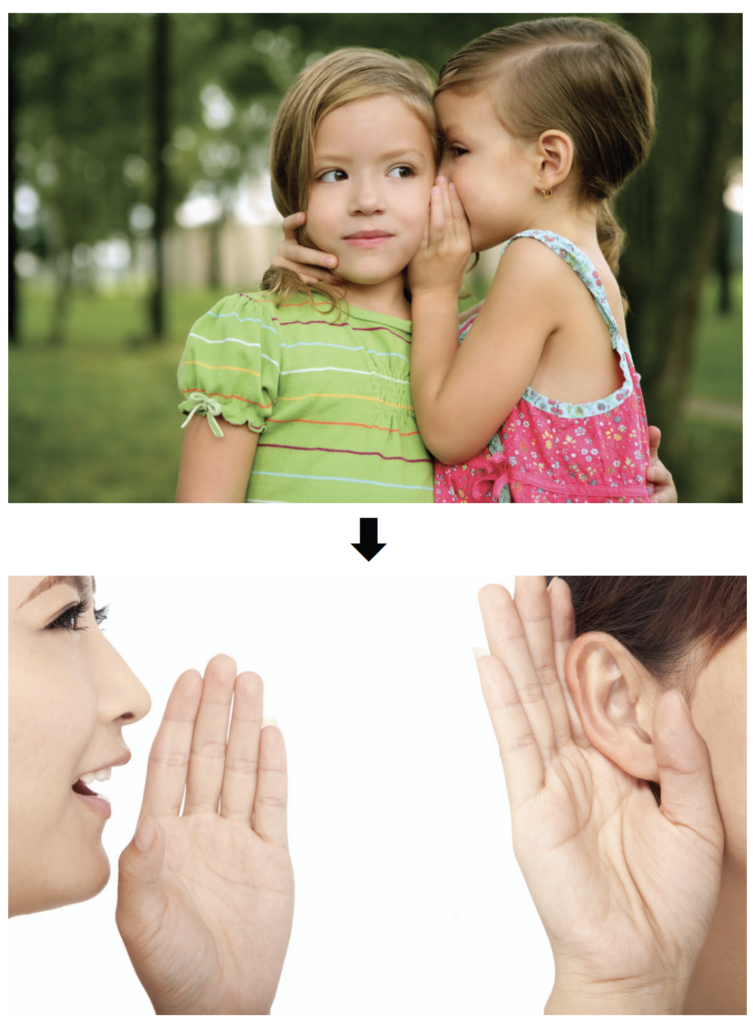
A MOUTH AND AN EAR IS ALL IT TAKES
Notice to all readers